1. Geography Optional Foundation Premium (Paid) Module
- Free Geography Optional: Course Schedule, Syllabus Tracker, Lecture Archive (YouTube/LMS embed).
- Premium Enrolment (The “Rank-Booster” Suite):
- Geography Optional Foundation 2026 (Lectures with Test Series and Value Added Materials)
- Foundation Test Series: Test Series (20 Sectional+2FLTs).
- CaseStudy@1000: Flagship Case Studies Program.
- Mentorship: 1-on-1 Personal Guidance.
- Resources: Blog, PYQ Analysis, Map Work.
- About Us: CivilPrep by Krishna Gupta
2. Freemium Section
- Master Geography Optional with Conceptual Clarity—For Free.
- Sub-headline: Join the Comprehensive Foundation Course by Krishna Gupta. 6 Days a Week. Zero Fees. 100% Syllabus Coverage.
- Primary: Start Learning for Free
- Secondary: Explore Test Series & Mentorship
Why Pay for Test Series, Case Studies & Value-Added Material?
The Core Difference: Knowledge vs. Mastery
Free lectures teach you what. Paid programs teach you how.
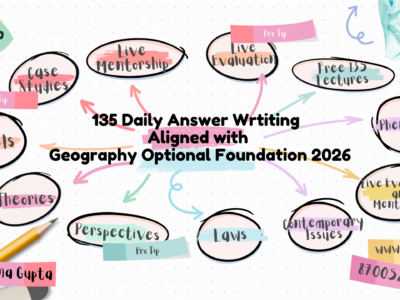
Self-study can make you knowledgeable. But UPSC examiners don’t reward knowledge ”they reward execution skill. Writing a 250-word geography answer under pressure, with perfect structure, perspectives, models, theories, laws, case studies, diagrams, and contemporary examples, requires practice and expert feedback.
The Evaluation Advantage
Without professional feedback, you cannot see your blind spots. Our expert evaluators assess every answer on 8 parameters: content accuracy, structure clarity, diagram effectiveness, time management, and UPSC alignment. You get comparative benchmarking against model answers and topper responses ”revealing exactly what separates a 220-mark answer from a 300-mark one.
Why Mentorship Matters
Candidates receiving structured mentor feedback on 20+ answers show 45-60 mark improvement from first mock to final exam. Generic YouTube advice cannot replicate personalized guidance on your specific weaknesses.
Foundation Test Series, CaseStudy@1000 & Value-Added Material
Examiners crave value addition: unique case studies, precise data, policy quotes. Standard textbooks don’t provide this. Our curated Foundation Test (20 Sectional + 2 FLTs) 1000+ case studies”linked to government reports, statistics, and contemporary events”convert “good answers” into “exceptional answers,” worth 15-25 extra marks across two papers each.
The ROI
If mentorship + case studies secure 30+ extra marks, pushing you from Rank 850 to Rank 520, it transforms your selection chances and posting allocation.
CivilPrep: Free Learning. Premium Mastery.
The Problem & Solution (Why CivilPrep?)
- Geography is Technical. We Make it Visual.
- “Most aspirants struggle not with content, but with visualization and application. At CivilPrep, we move beyond rote learning.
* Visual Learning: 3D Models & Animations for Climatology & Geomorphology.
* Scientific Approach: Taught by Krishna Gupta (IIT Kharagpur Alumnus & Faculty with 8+ Years Experience).
* Exam Relevance: Content strictly mapped to UPSC Mains trends and PYQs.”
3. “Free Foundation Course”
- The Complete Geography Optional Foundation
- Accessible Quality Education for Every Serious Aspirant.
- What You Get (Free Tier):
- ✅ Full Syllabus Coverage: From Geomorphology to Indian Geography.
- ✅ Daily Lectures: Monday to Saturday (Nov 2025 – March 2026).
- ✅ Concept Clarity: Deep dives into complex theories (Plate Tectonics, Slope Analysis, etc.).
- ✅ Current Affairs Integration: Dynamic linking of static topics with news.
- Why is it Free?
“We believe that conceptual guidance should not be a barrier. The lectures build your base; our paid programs build your rank.”
4. Premium/Paid Programs
Program 1: Geography Foundation Test Series
- Don’t Just Write Answers. Write Selection-Worthy Answers.
- The Most Scientific Test Series for Geography Optional.
- Key Features:
- 20 Sectional Tests + 2 Full-Length Tests: Rigorous practice aligned with the changing pattern of UPSC.
- Live Evaluation and Mentorship: Get line-by-line feedback within 72 hours while Live Evaluation.
- Model Answers: High-quality content enriched with diagrams and flowcharts.
- One-to-One Mentorship: Post-test calls with Krishna Gupta to fix your specific weaknesses.
- Call To Action: Enroll in Geography Optional Foundation Premium
Program 2: CaseStudy@1000 (Flagship Module)
- The Difference Between 220 and 300+ Marks.
- Body:
> “Examiners look for value addition—unique case studies, contemporary examples, and innovative diagrams. Standard books give you the theory; CaseStudy@1000 gives you the evidence.” - What’s Inside:
- 📁 1000+ Thematic Case Studies: From Urban Floods in Bengaluru to Glacial Lake Outbursts in Sikkim.
- 📊 Value-Added Material (VAM): Ready-to-use data snippets, committee reports, and scholar quotes.
- 🗺️ Map Enrichment: Special sessions on mapping and locations in news.
- Call To Action: Special Emphasis on Case Studies
5. About the Faculty/Mentor (Krishna Gupta)
- Name: Krishna Gupta
- Title: Founder, CivilPrep | Ex-Faculty in Various Institutes in New Delhi, Itanagar, Bangalore, Nagpur, etc.
- Bio:
“With over 8 years of academic rigor and teaching experience, Krishna Gupta is a distinguished faculty for Geography Optional. He brings a unique scientific temper to the subject, demystifying complex physical geography concepts through logic and visualization.
Having mentored thousands of students across top institutes in India, he founded CivilPrep to democratize high-quality education. His teaching methodology focuses on PYQ-rooted analysis, 3D visualization, and interdisciplinary linking—helping students transition from ‘reading’ geography to ‘thinking’ geographically.”
6. FAQ Section
- Q: Is the Foundation Course truly free?
- A: Yes. All lectures covering the static syllabus are available for free on our YouTube channel and www.civilprep.in website. There are no hidden charges for viewing the classes.
- Q: Why should I pay for the Test Series if lectures are free?
- A: Lectures build knowledge; the Test Series builds skill. Writing concise answers under time pressure requires practice and feedback. The paid enrollment also provides you with exclusive Foundation Test Series, RePrep: Live Evaluation and Mentorship, Case Studies (CaseStudy@1000) and Value Added Material that are not part of the free public lectures.
- Q: Does the course cover Indian Geography?
- A: Absolutely. We cover Paper 1 (Physical & Human) and Paper 2 (Indian Geography) comprehensively in the free foundation course.
- Q: How do I access the Value Added Material (VAM)?
- A: VAM documents, PDF notes, and the specific Case Studies repository are accessible via our LMS portal upon enrollment in the Geography Optional Foundation Premium, Test Series or the Mentorship program.
7. Call to Action
Course Features
- Lectures 136
- Quiz 0
- Duration 4.5 Months
- Skill level All levels
- Language English
- Students 35
- Certificate No
- Assessments Yes
- 20 Sections
- 136 Lessons
- 22 Weeks
- Unit VI - Paper I - Section B - Human Geography - Perspectives in Human GeographyPhysical geography26
- 1.1Introduction to Geography Optional Foundation 2026
- 1.21. Introduction to Human Geography & Ancient Classical Geography
- 1.3Assignment 1: Perspective 1
- 1.42. The Classical Debates : Paradigms, Paradigm Shift, Determinism & Possibilism,
- 1.5Assignment 2: Perspective
- 1.63. Areal Differentiation & Regional Synthesis
- 1.7Assignment 3: Perspective
- 1.84. Quantitative Revolution (QR) & Locational Analysis
- 1.9Assignment 4: Perspective
- 1.105. Behavioral Approach in Geography
- 1.11Assignment 5: Perspective
- 1.126. Humanist Approach in Geography
- 1.13Assignment 6: Perspective
- 1.147. Radical, Marxist and Functionalist Approach in Geography
- 1.15Assignment 7: Perspective
- 1.168. Welfare Approach in Geography
- 1.17Assignment 8: Perspective
- 1.189. Environmentalism in Geography
- 1.19Assignment 9: Perspective
- 1.2010. Religion, Secularisation and Language in Geography
- 1.21Assignment 10: Perspective
- 1.2211. Cultural Regions in the World
- 1.23Assignment 11: Perspective
- 1.2412. Human Development Index
- 1.25Assignment 12: Perspective
- 1.271.Test Perspectives in Human Geography
- Unit VII - Paper I - Section B - Human Geography - Economic GeographyEconomic Geography16
- 2.113. World Economic Development: Measurement, Paradigms & Regional Disparities
- 2.2Assignment 13: Economic Geography
- 2.314. World Resources: Classification, Non-Renewable Energy & Mineral Distribution
- 2.4Assignment 14: Economic Geography
- 2.515. Energy Crisis: Causes, Effects, Solutions & Hubbert’s Peak
- 2.6Assignment 15: Economic Geography
- 2.716. Limits to Growth: Concept, Criticism & Conclusions
- 2.8Assignment 16: Economic Geography
- 2.917. World Agriculture: Typology, Factors & Whittlesey’s Agricultural Regions
- 2.10Assignment 17: Economic Geography
- 2.1118. Agricultural Inputs, Productivity & Von Thunen’s Model
- 2.12Assignment 18: Economic Geography
- 2.1319. Food Security, Global Hunger Index & Famines
- 2.14Assignment 19: Economic Geography
- 2.1520. World Industries: Webber’s Theory, Location Patterns & Trade
- 2.16Assignment 20: Economic Geography
- Unit VIII - Paper I - Section B - Human Geography - Population and Settlement GeographyIndian Geography36
- 3.121. Population Distribution & Growth: World & Indian Patterns
- 3.2Assignment 21: Population and Settlement Geography
- 3.322. Theories of Population Growth: Malthusian, Marxist & Neo-Marxian
- 3.4Assignment 22: Population and Settlement Geography
- 3.523. Demographic Transition Model: Stages & India’s Position
- 3.6Assignment 23: Population and Settlement Geography
- 3.724. Demographic Attributes: Fertility & Mortality Determinants
- 3.8Assignment 24: Population and Settlement Geography
- 3.925. Migration: Types, Theories (Ravenstein, Lee, Zipf) & Causes
- 3.10Assignment 25: Population and Settlement Geography
- 3.1126. Consequences of Migration & Concepts of Population (Over, Under, Optimum)
- 3.12Assignment 26: Population and Settlement Geography
- 3.1327. World Population Problems & Policies
- 3.14Assignment 27: Population and Settlement Geography
- 3.1528. Social Well-being, Quality of Life & Population as Social Capital
- 3.16Assignment 28: Population and Settlement Geography
- 3.1729. Diversity in India: Racial, Linguistic, Ethnic & Religious Minorities
- 3.18Assignment 29: Population and Settlement Geography
- 3.1930. Tribes in India: Characteristics, Major Tribes & PVTGs
- 3.20Assignment 30: Population and Settlement Geography
- 3.2131. Rural Settlements: Types, Patterns, Morphology & Factors
- 3.22Assignment 31: Population and Settlement Geography
- 3.2332. Environmental Issues in Rural Settlements
- 3.24Assignment 32: Population and Settlement Geography
- 3.2533. Urban Settlement Hierarchy & Rank Size Rule
- 3.26Assignment 33: Population and Settlement Geography
- 3.2734. Primate Cities & Functional Classification of Towns
- 3.28Assignment 34: Population and Settlement Geography
- 3.2935. Rural-Urban Fringe & Satellite Towns
- 3.30Assignment 35: Population and Settlement Geography
- 3.3136. Classification & Morphology of Urban Areas
- 3.32Assignment 36: Population and Settlement Geography
- 3.3337. Central Place Theory: Christaller & Losch Models
- 3.34Assignment 37: Population and Settlement Geography
- 3.3538. Conurbation, Urban Sprawl, Agglomeration & Slums
- 3.36Assignment 38: Population and Settlement Geography
- Unit IX - Paper I - Section B - Human Geography - Regional PlanningRegional Planning14
- 4.139. Concept of Region: Attributes, Structure & Classification
- 4.2Assignment 39: Regional Planning
- 4.340. Growth Centres, Growth Poles
- 4.4Assignment 40: Regional Planning
- 4.541. Regional Imbalance, Regional development strategies;
- 4.6Assignment 41: Regional Planning
- 4.742. Environmental issues in regional planning; Planning for sustainable development
- 4.8Assignment 42: Regional Planning
- 4.943. Regional Development Strategies & Historical Background
- 4.10Assignment 43: Regional Planning
- 4.1144. IRDP, CAD & Water Management Programmes
- 4.12Assignment 44: Regional Planning
- 4.1345. Backward Area Development: Drought-Prone, Hill & Tribal Areas, Development of Islands in India
- 4.14Assignment 45: Regional Planning
- Unit X - Paper I - Section B - Human Geography - Models, Theories and Laws in Human geographyModels, Theories and Laws in Human geography18
- 5.146. System analysis in Human geography
- 5.2Assignment 46: Models, Theories and Laws
- 5.347. Malthusian, Marxian and demographic transition models;
- 5.4Assignment 47: Models, Theories and Laws
- 5.548. Central Place theories of Christaller and Losch
- 5.6Assignment 48: Models, Theories and Laws
- 5.749. Perroux and Boudeville
- 5.8Assignment 49: Models, Theories and Laws
- 5.950. Von Thunen’s model of agricultural location
- 5.10Assignment 50: Models, Theories and Laws
- 5.1151. Weber’s model of industrial location
- 5.12Assignment 51: Models, Theories and Laws
- 5.1352. Ostov’s model of stages of growth
- 5.14Assignment 52: Models, Theories and Laws
- 5.1553. Heartland and Rimland theories
- 5.16Assignment 53: Models, Theories and Laws
- 5.1754. Laws of international boundaries and frontiers
- 5.18Assignment 54: Models, Theories and Laws
- Unit I - Paper I - Section A - Physical Geography - GeomorphologyPhysical Geography - Geomorphology38
- 6.155. Factors Controlling Landform Development: Structure, Process, Time & Geomorphological Theories
- 6.2Assignment 55: Geomorphology
- 6.356. Endogenetic Forces: Diastrophism; Orogenetic & Epeirogenetic; Catastrophism
- 6.4Assignment 56: Geomorphology
- 6.557. Exogenetic Forces: Weathering (Physical, Chemical, Biological) & Mass Movement
- 6.6Assignment 57: Geomorphology
- 6.758. Origin & Evolution of Earth’s Crust: Nebular Hypothesis, Big Bang & Earth Evolution
- 6.8Assignment 58: Geomorphology
- 6.959. Geomagnetism: Magnetic Poles, Reversals, Sunspot & Dynamo Theory
- 6.10Assignment 59: Geomorphology
- 6.1160. Physical Conditions of Earth’s Interior: Sources, Evidences & Layers
- 6.12Assignment 60: Geomorphology
- 6.1361. Geosynclines: Theories (Kober, Hall, Dana, Haug) & Modern Concepts
- 6.14Assignment 61: Geomorphology
- 6.1562. Continental Drift: Taylor, Wegener, Sea Floor Spreading & Post-Drift Studies
- 6.16Assignment 62: Geomorphology
- 6.1763. Isostasy: Concepts of Airy, Pratt, Hayford, Bowie, Jolly & Holmes
- 6.18Assignment 63: Geomorphology
- 6.1964. Plate Tectonics: Plate Concepts, Motion, Causes & Evidences
- 6.20Assignment 64: Geomorphology
- 6.2165. Plate Tectonics & Mountain Building, Volcanism & Earthquakes
- 6.22Assignment 65: Geomorphology
- 6.2366. Volcanicity: Types, Classification, Landforms & World Distribution
- 6.24Assignment 66: Geomorphology
- 6.2567. Earthquakes & Tsunamis: Plate Tectonics, Distribution & Tsunami Generation
- 6.26Assignment 67: Geomorphology
- 6.2768. Geomorphic Cycles: Uniformitarianism & Davisian Cycle of Erosion
- 6.28Assignment 68: Geomorphology
- 6.2969. Landscape Development Theories: Cyclic (Davis, Penck, Gilbert, King) & Non-Cyclic Schools
- 6.30Assignment 69: Geomorphology
- 6.3170. Denudation Chronology: Principles, Evidences & Modern Concepts
- 6.32Assignment 70: Geomorphology
- 6.3371. Channel Morphology: Classification, Hydraulic Geometry & Channel Stability
- 6.34Assignment 71: Geomorphology
- 6.3572. Erosion Surfaces & Landforms: Karst, Fluvial, Aeolian, Coastal & Glacial
- 6.36Assignment 72: Geomorphology
- 6.3773. Slope Development & Applied Geomorphology: Planning, Hazards & Environment
- 6.38Assignment 73: Geomorphology
- Unit II - Paper I - Section A - Physical Geography - ClimatologyClimatology24
- 7.174. Atmospheric Composition, Structure & Gaia’s Hypothesis
- 7.2Assignment 74: Climatology
- 7.375. Temperature & Pressure Belts: Distribution & Seasonal Variations
- 7.4Assignment 75: Climatology
- 7.576. Heat Budget of Earth & Atmospheric Circulation: Tri-Cellular Model
- 7.6Assignment 76: Climatology
- 7.777. Atmospheric Stability, Instability & Temperature Inversion
- 7.8Assignment 77: Climatology
- 7.978. Planetary, Local & Seasonal Winds
- 7.10Assignment 78: Climatology
- 7.1179. Monsoons & Jet Streams: Mechanism, Types & Indian Climate
- 7.12Assignment 79: Climatology
- 7.1380. Air Masses & Fronts: Classification, Modification & Types
- 7.14Assignment 80: Climatology
- 7.1581. Temperate & Tropical Cyclones: Origin, Structure & Distribution
- 7.16Assignment 81: Climatology
- 7.1782. Thunderstorms, Tornadoes, Cloud Bursts & Water Spouts
- 7.18Assignment 82: Climatology
- 7.1983. Precipitation: Types, Distribution, Humidity, Fog & Clouds
- 7.20Assignment 83: Climatology
- 7.2184. Climatic Classification: Koppen, Thornthwaite & Trewartha
- 7.22Assignment 84: Climatology
- 7.2385. Hydrological Cycle, Global Climatic Change & Applied Climatology
- 7.24Assignment 85: Climatology
- Unit III - Paper I - Section A - Physical Geography - OceanographyOceanography18
- 8.186. Ocean Floor Mapping: Techniques, Hypsographic Curve & Marine Morphology
- 8.2Assignment 86: Oceanography
- 8.387. Bottom Topography of Atlantic, Pacific & Indian Oceans
- 8.4Assignment 87: Oceanography
- 8.588. Ocean Temperature & Salinity: Distribution & TS Curve
- 8.6Assignment 88: Oceanography
- 8.789. Heat Budget, Salt Budget & Ocean Deposits
- 8.8Assignment 89: Oceanography
- 8.990. Ocean Currents: Classification, Ekman Spiral & Deep Currents
- 8.10Assignment 90: Oceanography
- 8.1191. Oceanic Waves & Tides: Types, Theories & Variability
- 8.12Assignment 91: Oceanography
- 8.1392. Marine Resources: Biotic, Mineral & Energy Resources
- 8.14Assignment 92: Oceanography
- 8.1593. Coral Reefs: Types, Formation Theories, Bleaching & Conservation
- 8.16Assignment 93: Oceanography
- 8.1794. Sea Level Changes, UNCLOS & Marine Pollution
- 8.18Assignment 94: Oceanography
- Unit IV - Paper I - Section A - Physical Geography - BiogeographyBiogeography10
- 9.195. Genesis of Soils: Factors, Pedogenic Regime & Soil Classification
- 9.2Assignment 95: Biogeography
- 9.396. Soil Profile, Erosion, Degradation & Conservation Practices
- 9.4Assignment 96: Biogeography
- 9.597. Distribution of Plants & Animals: Factors, Biomes & Biogeographic Regions
- 9.6Assignment 97: Biogeography
- 9.798. Biological Phenomena: Speciation, Extinction & Dispersal
- 9.8Assignment 98: Biogeography
- 9.999. Deforestation, Conservation, Social & Agro-forestry; Gene Pool Centres
- 9.10Assignment 99: Biogeography
- Unit V - Paper I - Section A - Physical Geography - Environmental GeographyEnvironmental Geography10
- 10.1100. Principles of Ecology & Human Ecological Adaptations
- 10.2Assignment 100: Environmental Geography
- 10.3101. Anthropocene: Influence of Man on Ecology & Environment
- 10.4Assignment 101: Environmental Geography
- 10.5102. Global Ecological Changes & Ecosystem Management
- 10.6Assignment 102: Environmental Geography
- 10.7103. Environmental Degradation, Biodiversity & Sustainable Development
- 10.8Assignment 103: Environmental Geography
- 10.9104. Environmental Policy, Hazards, Legislation & Education
- 10.10Assignment 104: Environmental Geography
- Unit I - Paper II - Indian Geography - PHYSICAL SETTINGSPHYSICAL SETTINGS10
- 11.1105. Structure & Relief of India: Rock Systems & Land Diversities
- 11.2Assignment 105: Physical Settings – Paper II
- 11.3106. Space Relationship with Neighbours & Physiographic Regions
- 11.4Assignment 106: Physical Settings – Paper II
- 11.5107. Himalayas, Northern Plains & Peninsular Plateau
- 11.6Assignment 107: Physical Settings – Paper II
- 11.7108. Indian Monsoon Mechanism: Theories, Seasons & Rainfall Patterns
- 11.8Assignment 108: Physical Settings – Paper II
- 11.9109. Drainage Systems, Watersheds, Climatic Regions & Natural Vegetation
- 11.10Assignment 109: Physical Settings – Paper II
- Unit II - Paper II - Indian Geography - RESOURCESRESOURCES6
- Unit III - Paper II - Indian Geography - AGRICULTUREIndian Geography - AGRICULTURE8
- 13.1113. Agricultural Infrastructure: Irrigation, Seeds, Fertilizers & Power
- 13.2Assignment 113: AGRICULTURE – Paper II
- 13.3114. Land Holdings, Land Tenure & Land Reforms in India
- 13.4Assignment 114: AGRICULTURE – Paper II
- 13.5115. Cropping Patterns, Productivity, Intensity & Crop Combinations
- 13.6Assignment 115: AGRICULTURE – Paper II
- 13.7116. Green Revolution, White Revolution & Sustainable Agriculture
- 13.8Assignment 116: AGRICULTURE – Paper II
- Unit IV - Paper II - Indian Geography - INDUSTRYINDUSTRY6
- 14.1117. Industrial Evolution: Locational Factors & Types of Industries
- 14.2Assignment 117: INDUSTRY – Paper II
- 14.3118. Major Industries: Cotton, Jute, Iron & Steel, Aluminum, Fertilizer
- 14.4Assignment 118: INDUSTRY – Paper II
- 14.5119. Industrial Policy, SEZs, Multinationals & Tourism
- 14.6Assignment 119: INDUSTRY – Paper II
- Unit V - Paper II - Indian Geography - TRANSPORT, COMMUNICATION & TRADETRANSPORT, COMMUNICATION & TRADE4
- Unit VI - Paper II - Indian Geography - CULTURAL SETTINGCULTURAL SETTING6
- 16.1122. Historical Perspective: Racial, Linguistic, Ethnic & Religious Diversity
- 16.2Assignment 122: CULTURAL SETTING – Paper II
- 16.3123. Population: Growth, Distribution, Density & Demographic Attributes
- 16.4Assignment 123: CULTURAL SETTING – Paper II
- 16.5124. Migration, Population Problems, Policies & Health Indicators
- 16.6Assignment 124: CULTURAL SETTING – Paper II
- Unit VII - Paper II - Indian Geography - SETTLEMENTSSETTLEMENTS6
- 17.1125. Rural Settlements: Types, Patterns & Morphology in India
- 17.2Assignment 125: SETTLEMENTS – Paper II
- 17.3126. Urban Development: Morphology & Functional Classification of Cities
- 17.4Assignment 126: SETTLEMENTS – Paper II
- 17.5127. Conurbations, Urban Sprawl, Slums & Town Planning
- 17.6Assignment 127: SETTLEMENTS – Paper II
- Unit VIII - Paper II - Indian Geography - REGIONAL DEVELOPMENT & PLANNINGREGIONAL DEVELOPMENT & PLANNING6
- 18.1128. Regional Planning Experience: Five Year Plans & IRDP
- 18.2Assignment 128: REGIONAL DEVELOPMENT & PLANNING – Paper II
- 18.3129. Panchayati Raj, Command Area Development & Watershed Management
- 18.4Assignment 129: REGIONAL DEVELOPMENT & PLANNING – Paper II
- 18.5130. Multi-Level Planning: Backward, Drought, Hill & Tribal Areas
- 18.6Assignment 130: REGIONAL DEVELOPMENT & PLANNING – Paper II
- Unit IX - Paper II - Indian Geography - POLITICAL ASPECTSPOLITICAL ASPECTS6
- 19.1131. Indian Federalism: State Reorganization & Emergence of New States
- 19.2Assignment 131: POLITICAL ASPECTS- Paper II
- 19.3132. Regional Consciousness & Inter-State Issues
- 19.4Assignment 132: POLITICAL ASPECTS- Paper II
- 19.5133. International Boundaries: Issues, Cross-Border Terrorism & Geopolitics
- 19.6Assignment 133: POLITICAL ASPECTS- Paper II
- Unit X - Paper II - Indian Geography - CONTEMPORARY ISSUESCONTEMPORARY ISSUES4