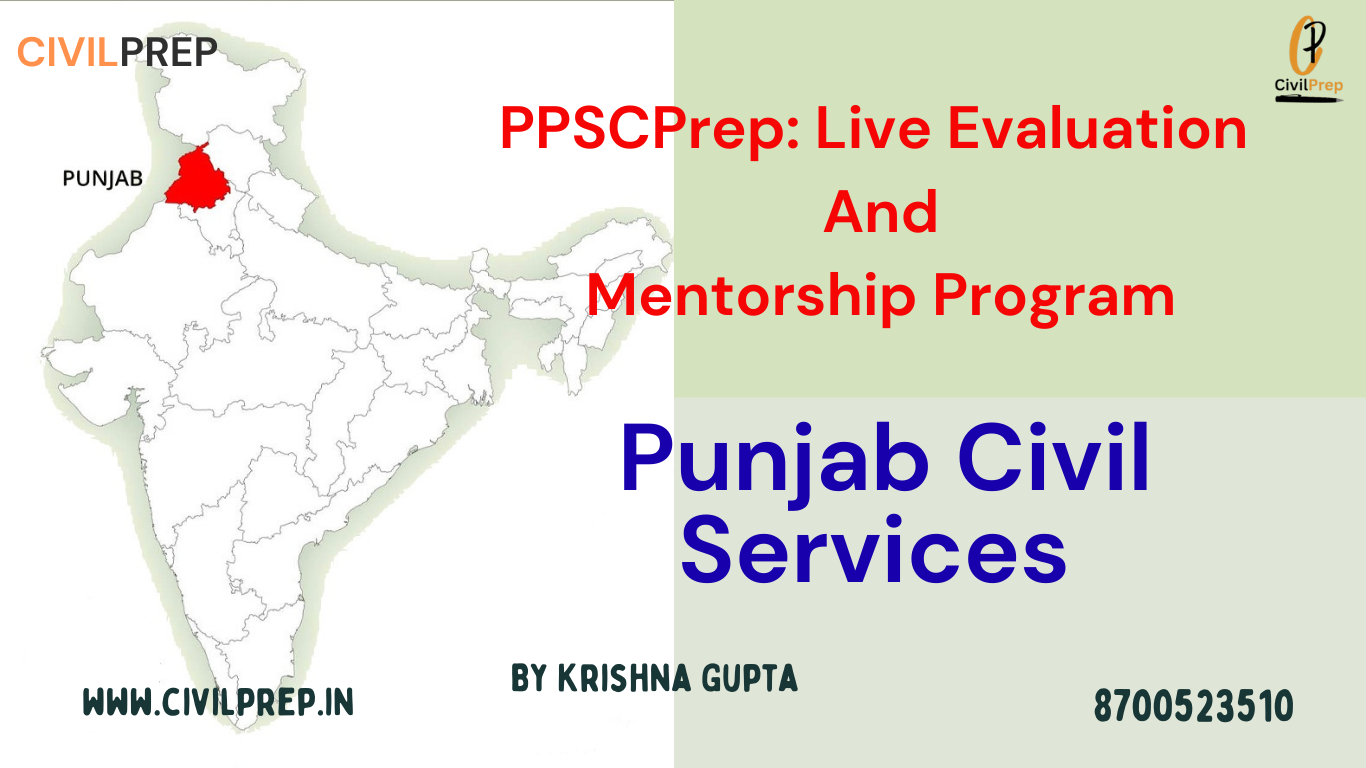
PPSC: Live Evaluation and Mentorship for GS
The Punjab Public Service Commission (PPSC) Examination Mains 2025 represents a pivotal stage in the selection process for various civil services posts in Punjab, testing candidates’ in-depth knowledge, analytical skills, and writing proficiency.
Following the preliminary exam, the Mains typically comprises seven compulsory papers, including four General Studies (GS) papers, two qualifying language papers (Punjabi and English), an Essay paper. Each GS paper carries 250 marks, emphasizing comprehensive coverage of subjects like history, geography, polity, economy, environment, science, and current affairs, with a focus on Punjab-specific issues. The total marks hover at1,500, excluding qualifying papers, and the exam demands precise time management amid descriptive questions.
PPSC: Live Evaluation and Mentorship Test Schedule
| Mon | Tue | Wed | Thurs | Fri | Sat | Sun | Subject. | |
| Week 1 | 12 | 13 | 14 | 15 | 16 | 17 | 18 | History |
| Week 2 | 19 | 20 | 21 | 22 | 23 | 24 | 25 | Geography |
| Week 3 | 26 | 27 | 28 | 29 | 30 | 31 | 1 | Society |
| Week 4 | 2 | 3 | 4 | 5 | 6 | 7 | 8 | Polity & Governance |
| Week 5 | 9 | 10 | 11 | 12 | 13 | 14 | 15 | International Relations |
| Week 6 | 16 | 17 | 18 | 19 | 20 | 21 | 22 | Economy |
| Week 7 | 23 | 24 | 25 | 26 | 27 | 28 | 1 | Stastistics |
| Week 8 | 2 | 3 | 4 | 5 | 6 | 7 | 8 | Environment |
| Week 9 | 9 | 10 | 11 | 12 | 13 | 14 | 15 | Science & Tech |
| Week 10 | 16 | 17 | 18 | 19 | 20 | 21 | 22 | Security Issues |
| Week 11 | 23 | 24 | 25 | 26 | 27 | 28 | 29 | Problem Solving & Decision Making |
| Week 12 | 30 | 31 | 1 | 2/ GS1 | 3 / GS2 | 4/ GS3 | 5/ GS4 | Combined GS Test |
Exam Preparation Insights
CivilPrep’s program, led by Krishna Gupta, offers live evaluation and personalized mentorship to bridge gaps in answer writing—a critical Mains skill. Candidates benefit from real-time feedback on structure, content depth, and relevance, aligning with PPSC’s evolving pattern that prioritizes Punjab-centric examples and data-driven responses. Regular mock tests mirror the actual three-hour papers, fostering endurance.
Strategic Tips
Focus on integrating static syllabus with dynamic current affairs, practicing 20-25 markers daily. Leverage mentorship for essay enrichment and optional subjects. With results influencing interviews, disciplined revision per the schedule ensures top ranks. Aim for balanced coverage to score 1,000+ in GS papers.
Gain Edge with Live Evaluation and Mentorship Program
Live evaluation and mentorship play a crucial role in excelling in the Punjab Public Service Commission (PPSC) Exam, particularly at the Mains stage, where answer writing determines success. Unlike self-study, live evaluation provides real-time, expert feedback on structure, content depth, and relevance, helping candidates align with PPSC’s expectations for analytical, Punjab-centric responses.
Key Benefits
Mentorship identifies blind spots in subjects like GS papers—history, polity, economy, and current affairs—offering personalized strategies to improve scores. CivilPrep’s program by Krishna Gupta simulates exam conditions through live sessions, ensuring timed practice for 250-mark papers. This iterative process boosts writing speed, argument coherence, and data integration, critical for 1,000+ totals.
Overcoming Challenges
Many aspirants struggle with vague answers or poor time management; mentorship counters this via mock tests and revisions, as per the uploaded schedule covering Polity, Economy, and Combined GS. It fosters discipline, reducing errors in descriptive questions.
Ensured Impact
Participants gain confidence for interviews, with tailored guidance elevating ranks. In competitive PPSC 2025, such support transforms average performers into toppers, emphasizing quality over quantity in preparation.
PPSC examination Mains Syllabus Covered in the Test Series
1. History
1.1 History of the world : Events from 18th century; industrial revolution, world wars, redrawal of national boundaries, colonization, decolonization, political philosophies like Communism, Capitalism, Socialism etc. -their forms and effect on society.
1.2 Indian culture- Salient aspects of Art Forms, Literature and Architecture from ancient to modern times.
1.3 Modern Indian history from the middle of the eighteenth century until the presentsignificant events, personalities and issues.
1.4 Socio-religious reform movements with special reference to Punjab.
1.5 The Freedom Struggle – its various stages and important contributors /contributions from different parts of the country with special reference to Punjab.
1.6 Post-independence consolidation and reorganization within the country.
1.7 History of Punjab:
1.7. 1 Ranjit Singh’s rise to power, civil and military administration and relations with the British
1.7. 2 Annexation of Punjab with special reference to the causes and consequences of the Anglo-Sikh wars.
2. Geography
- 2.1 Physical Geography: Salient features of world’s physical geography. Distribution of key natural resources across the world (including South Asia and the Indian subcontinent); factors responsible for the location of primary, secondary, and tertiary sector industries in various parts of the world (including India)
- 2.2 Important Geophysical phenomena such as earthquakes, Tsunami, Volcanic activity, cyclone etc., geographical features and their location- changes in critical geographical features (including water-bodies and ice-caps) and in flora and fauna and the effects of such changes.
- 2.3 Geography of Punjab:
- 2.3. 1 Physiographic details of Punjab; Geomorphic features of Punjab, Punjab’s strategic location with reference to International Border;
- 2.3. 2 Crops of Punjab; Modern concepts of Farming; Problems faced by agriculturists/ Issues in Agriculture: Depletion of ground water, etc;
3. Society
3.1 Salient features of Indian Society, Diversity of India.
3.2 Role of women and women’s organization, population and associated issues, poverty and developmental issues, urbanization, their problems and their remedies
3.3 Effects of globalization on Indian society
3.4 Social empowerment, communalism, regionalism & secularism
3.5 Ethics and Society: Essence, determinants and consequences of Ethics in human actions; dimensions of ethics; ethics in private and public relationships.
3. 6 Human Values – Role of family, society and educational institutions in inculcating values; lessons from the lives and teachings of great leaders and reformers- Gautam Buddha, Mahavira, Kabir, Guru Nanak; Swami Vivekananda, Jyotibha Phule, Ishwar Chandra Vidya Sagar and Mahatma Gandhi.
3.7 Vulnerable sections of the population – Welfare schemes by the Centre and State of Punjab and their performance; Mechanisms, laws, institutions and Bodies constituted for their protection and betterment.
3.8 Issues relating to development and management of Social Sector- Health, Education, Human Resources; Issues relating to Poverty and Malnutrition.
4. Economy
1.1 Indian Constitution- historical underpinnings, evolution, features, amendments, significant provisions and basic structure.
1.2 Functions and responsibilities of Union and the States, issues and challenges pertaining to the federal structure, devolution of powers and finances up to local levels and challenges therein.
1.3 Separation of powers between various organs; Dispute redressal mechanisms and institutions.
1.4 Comparison of the Indian constitutional scheme with that of other countries
1.5 Parliament and State Legislatures – structure, functioning, conduct of business, powers & privileges and issues arising out of these.
1.6 Structure, organization and functioning of the Executive and the Judiciary; Ministries and Departments of the Government; pressure groups and formal/informal associations and their role in the Polity.
1.7 Salient features of the Representation of People’s Act.
1.8 Appointment to various Constitutional posts; Powers, functions and responsibilities of various Constitutional Bodies
1.9 District Administration – Evolution of District Administration; Panchayati Raj Institutions and Urban Local Bodies.
5. Governance
2.1 Statutory, regulatory and various quasi-judicial bodies
2.2 Government policies and interventions for development in various sectors and issues arising out of their design and implementation; Development processes and the development organizations- the role of NGOs, SHGs, donors, charities, institutional and other stakeholders
2.3 Important aspects of governance, transparency and accountability, e-governanceapplications, models, successes, limitations and potential; citizens charters, transparency & accountability and institutional and other measures; Role of civil services in a democracy; Changing trends in Governance
2.4 Values and Ethics in Governance- Ethical concerns and dilemmas in government and private institutions; laws, rules, regulations and conscience as sources of ethical guidance; accountability and ethical governance; strengthening of ethical and moral values in governance; ethical issues in international relations and funding.
2.5 Probity in Governance: Concept of Governance; Philosophical basis of governance and probity; corporate governance; Information sharing and transparency in government, Right to Information, Codes of Ethics, Codes of Conduct, Citizen’s Charters, Work culture, Quality of service delivery, Utilization of public funds, challenges of corruption.
6. International Relations
3.1 India and its neighborhood- relations;
3.2 Bilateral, regional and global groupings and agreements involving India and/or affecting India’s interests;
3.3 Effect of policies and politics of developed and developing countries on India’s interests, Indian Diaspora
3.4 Important International institutions, agencies and fora- their structure and mandate.
Note: The candidates are expected to be aware about the current developments related to the topics mentioned above.
7. Indian Economy
1.1 Issues relating to planning, mobilization of resources, growth, development and employment; sustainable development; Inclusive growth and issues arising from it; Government Budgeting;
1.2 Major crops, cropping patterns in various parts of the country, different types of irrigation and irrigation systems; storage, transport and marketing of agricultural produce- issues and related constraints; e-technology in the aid of farmers; Issues related to direct and indirect farm subsidies and minimum support prices; Technology missions; economics of animal rearing.
1.3 Public Distribution System- objectives, functioning, limitations, revamping; issues of buffer stocks and food security;
1.4 Food processing and related industries in India- scope and significance, location, upstream and downstream requirements, supply chain management
1.5 Land reforms in India; Effects of liberalization on the economy, changes in industrial policy and their effects on industrial growth.
1.6 Infrastructure- Energy, Ports, Roads, Airports, Railways etc; Investment models
1.7 Human Resource Development:
1.7.1 Importance of Human capital in economic development
1.7.2 Nature, types and problems of unemployment in India, Trends of Employment in India, Skill development and demographic dividend
1.8 Punjab Economy: Planning- various aspects of developmental planning; Industry; Infrastructure.
8. Statistical Analysis, Graphs and Diagrams
This part will test the candidate’s ability to draw conclusions from information presented in statistical, graphical or diagrammatical form and to interpret the same.
9. Issues related to Security
3.1 Linkages between development and spread of extremism;
3.2 Role of external, State and non-State actors in creating challenges to internal security; Challenges to internal security through communication networks; role of media and social networking sites in internal security challenges,
3.3 Basics of cyber security; money-laundering and its prevention;
3.4 Security challenges and their management in border areas; linkages of organized crime with terrorism.
3.5 Various Security forces and agencies and their mandate
Note: The candidates are expected to be aware about the current developments related to the topics mentioned above.
10. Science and Technology
1.1 Science and Technology
1.1.1 Developments and applications of science and technology and their effects in everyday life
1.1.2 Achievements of Indians in science & technology; indigenization of technology and developing new technology.
1.1.3 Recent developments in the fields of IT, Space, Computers, robotics, nanotechnology, etc.
1.1.4 Issues relating to intellectual property rights.
1.2 Modern Trends in Life Sciences
1.2.1 Progress of Agricultural Science and its impact– Introduction to Biotechnology and its applications; Veterinary and Animal Sciences- latest developments.
1.2.2 Introduction to and applications of Genetic Engineering & Stem Cell Research
1.2.3 Human Diseases and Microbial infections; Common infections and preventive measures; preventive measures during out breaks; Immunity and vaccination
11. Environment
2.1 Conservation, environmental pollution and degradation, Issues related to Climate change; environmental impact assessment
2.2 Water management- Issues in India; Present scenario, Methods and importance of water conservation
2.3 Definition, nature, types and classification of disasters
2.4 Natural Hazards: Floods, earthquakes, tsunamis, landslides, etc., Risk reduction and mitigation measures
12. Situations in Civil Service -Problem Solving and Decision Making
3.1 Tackling situations of Natural disasters/ Major Accidents/ Law and order, Controlling riots, Handling public protests and dharnas, Land Acquisition and Rehabilitation, Designing Projects, Implementation of National Flagship Schemes/ Programmmes, Public Private Partnership in effective service delivery, Managing and financing Municipal services e.g. Solid waste management, Conservation of natural resources- water, forests, etc, Pollution control, Reviving a loss making PSU, Planning and target achievement, Gender sensitization and women empowerment, Empowerment of vulnerable sections of the society, Improving Education and Enhancing Skill development, Urban settlement-Slums and Housing issues, Managing Issues related to Urban/ Rural drinking water supply and sanitation, etc. Note: A duly structured situation will be presented to the candidates and they will be asked to analyze and suggest their own solution to the problem arising out of situation.
Course Features
- Lecture 0
- Quiz 0
- Duration 12 Weeks
- Skill level All levels
- Language English
- Students 0
- Certificate No
- Assessments Yes
- 15 Sections
- 0 Lessons
- 12 Weeks
- Test 1 - History1. History 1.1 History of the world : Events from 18th century; industrial revolution, world wars, redrawal of national boundaries, colonization, decolonization, political philosophies like Communism, Capitalism, Socialism etc. -their forms and effect on society. 1.2 Indian culture- Salient aspects of Art Forms, Literature and Architecture from ancient to modern times. 1.3 Modern Indian history from the middle of the eighteenth century until the presentsignificant events, personalities and issues. 1.4 Socio-religious reform movements with special reference to Punjab. 1.5 The Freedom Struggle - its various stages and important contributors /contributions from different parts of the country with special reference to Punjab. 1.6 Post-independence consolidation and reorganization within the country. 1.7 History of Punjab: 1.7. 1 Ranjit Singh’s rise to power, civil and military administration and relations with the British 1.7. 2 Annexation of Punjab with special reference to the causes and consequences of the Anglo-Sikh wars.1
- Test 2 - Geography2. Geography 2.1 Physical Geography: Salient features of world’s physical geography. Distribution of key natural resources across the world (including South Asia and the Indian subcontinent); factors responsible for the location of primary, secondary, and tertiary sector industries in various parts of the world (including India) 2.2 Important Geophysical phenomena such as earthquakes, Tsunami, Volcanic activity, cyclone etc., geographical features and their location- changes in critical geographical features (including water-bodies and ice-caps) and in flora and fauna and the effects of such changes. 2.3 Geography of Punjab: 2.3. 1 Physiographic details of Punjab; Geomorphic features of Punjab, Punjab’s strategic location with reference to International Border; 2.3. 2 Crops of Punjab; Modern concepts of Farming; Problems faced by agriculturists/ Issues in Agriculture: Depletion of ground water, etc;0
- Test 3 - Society3. Society 3.1 Salient features of Indian Society, Diversity of India. 3.2 Role of women and women’s organization, population and associated issues, poverty and developmental issues, urbanization, their problems and their remedies 3.3 Effects of globalization on Indian society 3.4 Social empowerment, communalism, regionalism & secularism 3.5 Ethics and Society: Essence, determinants and consequences of Ethics in human actions; dimensions of ethics; ethics in private and public relationships. 3. 6 Human Values – Role of family, society and educational institutions in inculcating values; lessons from the lives and teachings of great leaders and reformers- Gautam Buddha, Mahavira, Kabir, Guru Nanak; Swami Vivekananda, Jyotibha Phule, Ishwar Chandra Vidya Sagar and Mahatma Gandhi. 3.7 Vulnerable sections of the population - Welfare schemes by the Centre and State of Punjab and their performance; Mechanisms, laws, institutions and Bodies constituted for their protection and betterment. 3.8 Issues relating to development and management of Social Sector- Health, Education, Human Resources; Issues relating to Poverty and Malnutrition.0
- Test 4 - Polity & Governance4. Polity 1.1 Indian Constitution- historical underpinnings, evolution, features, amendments, significant provisions and basic structure. 1.2 Functions and responsibilities of Union and the States, issues and challenges pertaining to the federal structure, devolution of powers and finances up to local levels and challenges therein. 1.3 Separation of powers between various organs; Dispute redressal mechanisms and institutions. 1.4 Comparison of the Indian constitutional scheme with that of other countries 1.5 Parliament and State Legislatures - structure, functioning, conduct of business, powers & privileges and issues arising out of these. 1.6 Structure, organization and functioning of the Executive and the Judiciary; Ministries and Departments of the Government; pressure groups and formal/informal associations and their role in the Polity. 1.7 Salient features of the Representation of People’s Act. 1.8 Appointment to various Constitutional posts; Powers, functions and responsibilities of various Constitutional Bodies 1.9 District Administration - Evolution of District Administration; Panchayati Raj Institutions and Urban Local Bodies. 5. Governance 2.1 Statutory, regulatory and various quasi-judicial bodies 2.2 Government policies and interventions for development in various sectors and issues arising out of their design and implementation; Development processes and the development organizations- the role of NGOs, SHGs, donors, charities, institutional and other stakeholders 2.3 Important aspects of governance, transparency and accountability, e-governanceapplications, models, successes, limitations and potential; citizens charters, transparency & accountability and institutional and other measures; Role of civil services in a democracy; Changing trends in Governance 2.4 Values and Ethics in Governance- Ethical concerns and dilemmas in government and private institutions; laws, rules, regulations and conscience as sources of ethical guidance; accountability and ethical governance; strengthening of ethical and moral values in governance; ethical issues in international relations and funding. 2.5 Probity in Governance: Concept of Governance; Philosophical basis of governance and probity; corporate governance; Information sharing and transparency in government, Right to Information, Codes of Ethics, Codes of Conduct, Citizen’s Charters, Work culture, Quality of service delivery, Utilization of public funds, challenges of corruption.0
- Test 5 - International Relations6. International Relations 3.1 India and its neighborhood- relations; 3.2 Bilateral, regional and global groupings and agreements involving India and/or affecting India’s interests; 3.3 Effect of policies and politics of developed and developing countries on India’s interests, Indian Diaspora 3.4 Important International institutions, agencies and fora- their structure and mandate. Note: The candidates are expected to be aware about the current developments related to the topics mentioned above.0
- Test 6 - Economy7. Indian Economy 1.1 Issues relating to planning, mobilization of resources, growth, development and employment; sustainable development; Inclusive growth and issues arising from it; Government Budgeting; 1.2 Major crops, cropping patterns in various parts of the country, different types of irrigation and irrigation systems; storage, transport and marketing of agricultural produce- issues and related constraints; e-technology in the aid of farmers; Issues related to direct and indirect farm subsidies and minimum support prices; Technology missions; economics of animal rearing. 1.3 Public Distribution System- objectives, functioning, limitations, revamping; issues of buffer stocks and food security; 1.4 Food processing and related industries in India- scope and significance, location, upstream and downstream requirements, supply chain management 1.5 Land reforms in India; Effects of liberalization on the economy, changes in industrial policy and their effects on industrial growth. 1.6 Infrastructure- Energy, Ports, Roads, Airports, Railways etc; Investment models 1.7 Human Resource Development: 1.7.1 Importance of Human capital in economic development 1.7.2 Nature, types and problems of unemployment in India, Trends of Employment in India, Skill development and demographic dividend 1.8 Punjab Economy: Planning- various aspects of developmental planning; Industry; Infrastructure.0
- Test 7 - Stastistics8. Statistical Analysis, Graphs and Diagrams This part will test the candidate’s ability to draw conclusions from information presented in statistical, graphical or diagrammatical form and to interpret the same.0
- Test 8 - Environment8. Environment 2.1 Conservation, environmental pollution and degradation, Issues related to Climate change; environmental impact assessment 2.2 Water management- Issues in India; Present scenario, Methods and importance of water conservation 2.3 Definition, nature, types and classification of disasters 2.4 Natural Hazards: Floods, earthquakes, tsunamis, landslides, etc., Risk reduction and mitigation measures0
- Test 9 - Science & Tech9. Science and Technology 1.1 Science and Technology 1.1.1 Developments and applications of science and technology and their effects in everyday life 1.1.2 Achievements of Indians in science & technology; indigenization of technology and developing new technology. 1.1.3 Recent developments in the fields of IT, Space, Computers, robotics, nanotechnology, etc. 1.1.4 Issues relating to intellectual property rights. 1.2 Modern Trends in Life Sciences 1.2.1 Progress of Agricultural Science and its impact– Introduction to Biotechnology and its applications; Veterinary and Animal Sciences- latest developments. 1.2.2 Introduction to and applications of Genetic Engineering & Stem Cell Research 1.2.3 Human Diseases and Microbial infections; Common infections and preventive measures; preventive measures during out breaks; Immunity and vaccination0
- Test 10 - Security Issues10. Issues related to Security 3.1 Linkages between development and spread of extremism; 3.2 Role of external, State and non-State actors in creating challenges to internal security; Challenges to internal security through communication networks; role of media and social networking sites in internal security challenges, 3.3 Basics of cyber security; money-laundering and its prevention; 3.4 Security challenges and their management in border areas; linkages of organized crime with terrorism. 3.5 Various Security forces and agencies and their mandate Note: The candidates are expected to be aware about the current developments related to the topics mentioned above.0
- Test 11 - Problem Solving & Decision Making11. Situations in Civil Service -Problem Solving and Decision Making 3.1 Tackling situations of Natural disasters/ Major Accidents/ Law and order, Controlling riots, Handling public protests and dharnas, Land Acquisition and Rehabilitation, Designing Projects, Implementation of National Flagship Schemes/ Programmmes, Public Private Partnership in effective service delivery, Managing and financing Municipal services e.g. Solid waste management, Conservation of natural resources- water, forests, etc, Pollution control, Reviving a loss making PSU, Planning and target achievement, Gender sensitization and women empowerment, Empowerment of vulnerable sections of the society, Improving Education and Enhancing Skill development, Urban settlement-Slums and Housing issues, Managing Issues related to Urban/ Rural drinking water supply and sanitation, etc. Note: A duly structured situation will be presented to the candidates and they will be asked to analyze and suggest their own solution to the problem arising out of situation.0
- Test 12 - General Studies 11. History 2. Geography 3. Society0
- Test 13 - General Studies 21. Polity 2. Governance 3. International Relations0
- Test 14 - General Studies 31. Economics 2. Statistics 3. Security Issues0
- Test 15 - General Studies 41. Science & Technology 2. Environment 3. Problem Solving and Decision Making0