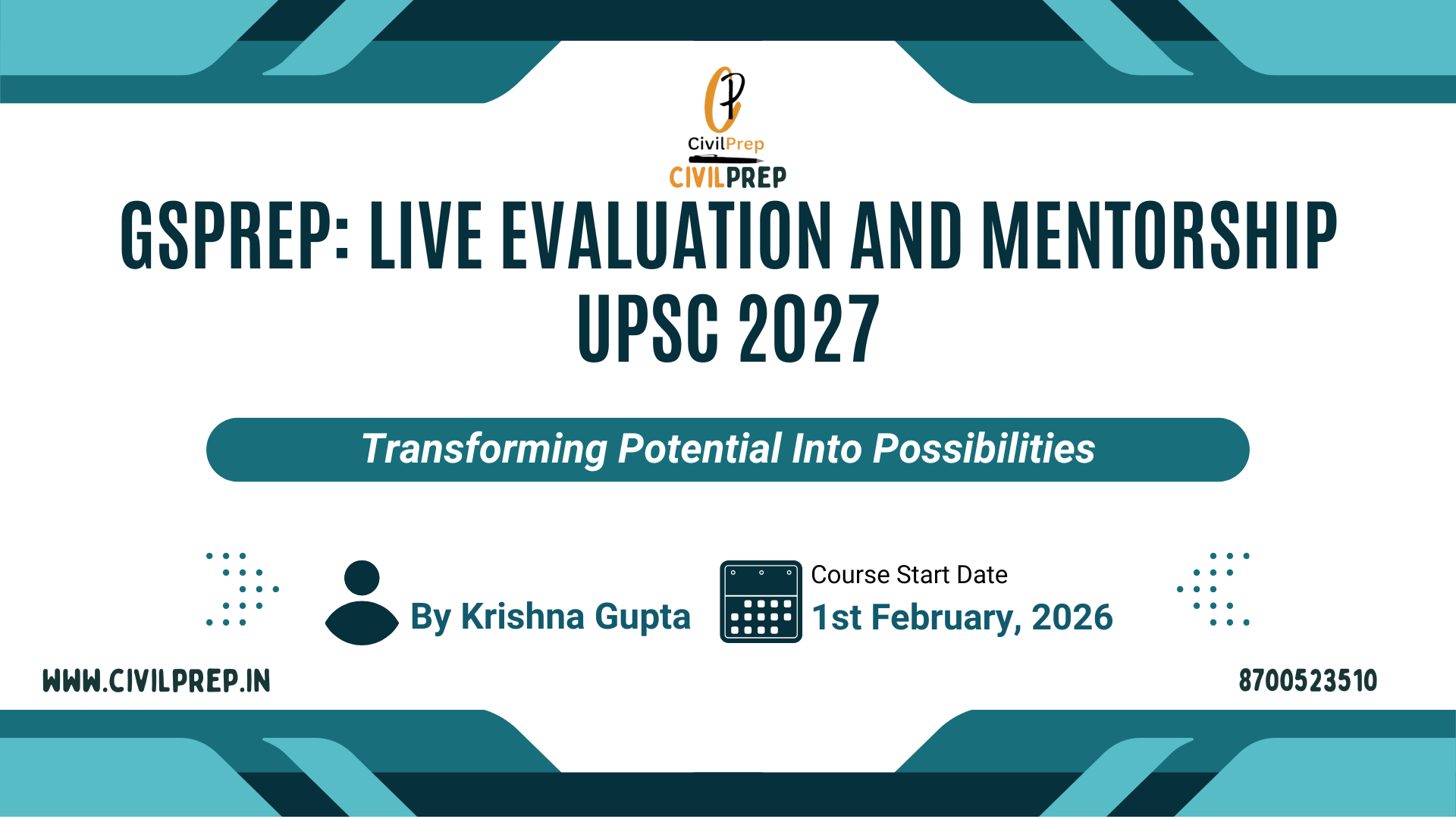
CivilPrep – Transforming Potential into Possibilities. Led by Krishna Gupta, CivilPrep has redefined UPSC preparation with its proven track record, including 100+ selections in Top 100from Geography Optional. Now, Krishna Gupta brings GSPrep: Live Evaluation and Mentorship – a 12-month powerhouse program designed to make UPSC CSE 2027 aspirants Mains-ready before Prelims. This isn’t just another test series; it’s a personalized transformation journey that equips you with exam-ready skills, structured thinking, and the confidence to score 450+ in GS papers and 125+ in Essay.
Demo Video:
1. About GSPrep: Live Evaluation and Mentorship
GSPrep is CivilPrep’s flagship program for UPSC Mains General Studies (GS1, GS2, GS3, GS4) and Essay, crafted by Krishna Gupta to solve the biggest pain point of serious aspirants: answer writing. Krishna Gupta, with his deep understanding of UPSC’s evaluation patterns and years of mentoring top rankers, has designed GSPrep to deliver live, interactive evaluation and one-on-one mentorship for 300+ answer writing questions.
Unlike generic test series where you submit answers and wait weeks for templated feedback, GSPrep offers real-time evaluation sessions where Krishna Gupta himself dissects your answers LIVE, highlighting gaps in structure, multidimensionality, keyword usage, and examiner expectations. Each session includes actionable improvement plans so you see measurable progress week after week.
The program follows CivilPrep’s philosophy: “Transforming Potential into Possibilities” by identifying your weaknesses early, building exam-ready frameworks, and maintaining consistent momentum through personalized guidance. Whether you’re a working professional, repeater stuck at 100-110 marks, or beginner needing structure, GSPrep adapts to your needs.
Krishna Gupta’s Edge: His sessions emphasize PYQ-driven preparation, current affairs integration, and multidimensional analysis – the exact skills that separate top rankers from the rest. Past students rave about how his live doubt resolution and motivational mentoringturned vague answers into 140+ scoring masterpieces.
1.1 Test Schedule
| Sr. No. | Subject | Quest | Topics | Date |
| 1 | History | 10 | Art and Culture | 14 Feb 2026 |
| 2 | History | 10 | Modern History | 28 Feb 2026 |
| 3 | History | 10 | World History | 14 Mar 2026 |
| 4 | Geography | 10 | Physical Geography | 28 Mar 2026 |
| 5 | Geography | 10 | Human & Economic Geography | 11 Apr 2026 |
| 6 | Geography | 10 | Indian Geography | 25 Apr 2026 |
| 7 | Indian Society | 10 | Indian Society – I | 9 May 2026 |
| 8 | Indian Society | 10 | Indian Society – II | 30 May 2026 |
| 9 | Polity & Constitution | 10 | Polity | 13 Jun 2026 |
| 10 | Polity & Constitution | 10 | Constitution | 27 Jun 2026 |
| 11 | Governance | 10 | Governance – I | 11 Jul 2026 |
| 12 | Governance | 10 | Governance – II | 25 Jul 2026 |
| 13 | International Relations | 10 | International Relations | 8 Aug 2026 |
| 14 | Economy | 10 | Economy – I | 22 Aug 2026 |
| 15 | Economy | 10 | Economy – II | 5 Sep 2026 |
| 16 | Science & Technology | 10 | Science & Tech – I | 19 Sep 2026 |
| 17 | Science & Technology | 10 | Science & Tech – II | 3 Oct 2026 |
| 18 | Environment | 10 | Environment & Ecology – I | 17 Oct 2026 |
| 19 | Environment | 10 | Environment & Ecology – II | 31 Oct 2026 |
| 20 | Internal Security | 10 | Internal Security | 14 Nov 2026 |
| 21 | Disaster Management | 10 | Disaster Management | 28 Nov 2026 |
| 22 | Ethics | 10 | Ethics, Aptitude & Integrity | 12 Dec 2026 |
| 23 | Ethics | 10 | Ethics Case Studies | 19 Dec 2026 |
| 24 | Essay | 1 | Essay – I | 26 Dec 2026 |
| 25 | Essay | 1 | Essay – II | 2 Jan 2027 |
| 26 | GS I – FLT | 20 | History, Geography & Society | 9 Jan 2027 |
| 27 | GS II – FLT | 20 | Polity, Constitution, Governance & IR | 16 Jan 2027 |
| 28 | GS III – FLT | 20 | Economy, S&T, Environment, DM & IS | 23 Jan 2027 |
| 29 | GS IV – FLT | 20 | Ethics & Case Studies | 30 Feb 2027 |
| 30 | Essay – FLT | 2 | Two Essay Questions | 6 Feb 2027 |
2. Comprehensive Syllabus Coverage – GS1 to GS4 + Essay
GSPrep provides end-to-end coverage of the UPSC Mains syllabus, meticulously aligned with PYQs, current affairs, and contemporary issues. Every topic is broken down into practice-ready modules:
- GS1: Indian Heritage & Culture, Modern History, World History, Society, Geography (Physical, Human, Indian)
- GS2: Polity & Constitution, Governance, Social Justice, International Relations
- GS3: Economy, Agriculture, Environment, Science & Tech, Disaster Management, Security
- GS4: Ethics, Integrity, Aptitude (Theory + Case Studies)
- Essay: Philosophical, Socio-economic, Current Affairs-based themes
Krishna Gupta ensures 360° coverage with concept refreshers, model answers, diagrams, data points, and value addition techniques. Weekly current affairs modules link static syllabus to dynamic UPSC trends, so your answers always feel fresh and relevant.
3. 30 High-Quality Tests (25 Sectional + 5 Full-Length Tests)
GSPrep’s backbone is its rigorous 30-test structure, simulating real exam pressure while building progressive mastery:
- 25 Sectional Tests: Topic-wise and sub-topic tests for GS1-GS4 + Essay (e.g., Polity in GS2, Economy in GS3, Ethics case studies)
- 5 Full-Length Tests (FLTs): Complete Mains marathon simulating 3-hour papers with back-to-back GS sessions
Each test includes timed practice (9 minutes per answer), followed by live evaluation where Krishna Gupta reviews top submissions on-screen, demonstrating improvements. You get detailed written feedback on all 300+ questions, tracking metrics like structure (20%), content depth (30%), multidimensionality (25%), and presentation (25%).
4. Live Evaluation & Mentorship vs Normal Copy Evaluation
| Aspect | GSPrep: Live Evaluation & Mentorship | Normal Copy Evaluation |
|---|---|---|
| Feedback Type | ✓ Live, interactive, personalized by Krishna Gupta | ✗ Delayed, generic template feedback |
| Doubt Resolution | ✓ Instant during live sessions | ✗ None or email-based (weeks later) |
| Weakness Analysis | ✓ Detailed gap identification + improvement roadmap | ✗ Basic marks/remarks only |
| Answer Improvement | ✓ Weekly progress tracking (30-50 mark jumps) | ✗ Plateaued scores, no follow-up |
| Mentorship | ✓ One-on-one strategy sessions | ✗ Zero guidance beyond scores |
| Exam Simulation | ✓ Timed + live pressure handling | ✗ Untimed, no real pressure |
| Current Affairs Linkage | ✓ PYQ + CA integration taught live | ✗ Rarely covered |
| Confidence Building | ✓ Motivation + peer learning | ✗ Demotivating low scores |
Live Evaluation Advantage: Krishna Gupta’s real-time corrections help you internalize frameworks instantly, turning common mistakes into strengths.
5. Proven Achievement: 450+ in GS and 125+ in Essay
GSPrep students consistently outperform through targeted skill-building:
- 450+ in GS Papers: Average jump of 40-60 marks across GS1-GS4 via multidimensional answers
- 125+ in Essay: Structured intros, powerful conclusions, diverse themes mastered
- Overall 1000+ Marks: Positions you for interview calls and top ranks
Real Results from Krishna Gupta’s Batches:
- 70% students clear Mains cut-off comfortably
- 40% achieve 120+ per GS paper
- Multiple students cross 140+ in individual papers
Krishna Gupta’s data-backed approach – tracking 10+ parameters per answer – ensures predictable score improvements.
6. 12-Month Program: Mains-Ready Before Prelims 2027
Batch Starts: February 15, 2026 – Perfect timing for UPSC CSE 2027.
Program Timeline:
- Months 1-3: Foundation building + sectional tests (GS1 focus)
- Months 4-6: Advanced practice + GS2/GS3 sectional tests
- Months 7-9: GS4/Essay mastery + mixed sectional tests
- Months 10-12: 5 FLTs + intensive revision + rank refinement
Weekly Structure:
Flexible for Working Professionals: Recorded sessions, weekend intensives, and bite-sized assignments fit busy schedules.
Why Choose Krishna Gupta’s GSPrep at CivilPrep?
Krishna Gupta isn’t just a mentor; he’s a rank-maker. His Geography Optional success proves his ability to decode UPSC patterns. GSPrep applies the same winning formula to General Studies.
CivilPrep’s Promise – Transforming Potential into Possibilities:
- From disorganized answers to examiner-pleasing structures
- From surface-level knowledge to multidimensional mastery
- From self-doubt to top-rank confidence
Enroll Today: Limited seats for the Feb 15 batch. Join thousands who’ve transformed under Krishna Gupta’s guidance. Your top rank starts with GSPrep.
Links: Telegram | Youtube | Whatsapp | Instagram | Facebook
Is Your OPTIONAL GEOGRAPHY?
You can go through the RePrep, A Comprehensive Course for Achieving Minimum 280+ in UPSC 2027
Course Features
- Lecture 0
- Quiz 0
- Duration 1 Year
- Skill level All levels
- Language English
- Students 66
- Certificate No
- Assessments Yes
- 30 Sections
- 0 Lessons
- 55 Weeks
- 1. History - Art and Culture (10Q)Art and Culture – Architecture, sculpture, painting, performing arts, literature, salient features of Indian culture.0
- 2. History - Modern History (10Q)Modern History – 18th century to independence, freedom struggle phases, important leaders, reform movements.0
- 3. History - World History (10Q)World History – Industrial revolution, world wars, colonization–decolonization, redrawing of national boundaries, political ideologies.0
- 4. Geography - Physical Geography (10Q)Physical Geography – Landforms, geomorphology, climatology, oceanography, distribution of key natural resources.0
- 5. Geography - Human & Economic Geography (10Q)Human & Economic Geography – Population, migration, urbanization, resources, industries, trade, regional development.0
- 6. Geography - Indian Geography (10Q)Indian Geography – Indian physiography, climate, rivers, agriculture, minerals, industries, transport.0
- 7. Indian Society - Indian Society I (10Q)Indian Society – I – Salient features of Indian society, diversity, women and vulnerable sections, social empowerment.0
- 8. Indian Society - Indian Society II (10Q)Indian Society – II – Communalism, regionalism, secularism, globalization and its impact on Indian society.0
- 9. Polity & Constitution - Polity (10Q)Polity – Parliament, State legislatures, Executive, Judiciary, federalism, local bodies, pressure groups.0
- 10. Polity & Constitution - Constitution (10Q)Constitution – Features, Preamble, FRs, DPSPs, FDs, constitutional and statutory bodies, amendments.0
- 11. Governance - Governance – I (10Q)Governance – I – Governance, transparency, accountability, e‑governance, citizen charters, RTI.0
- 12. Governance - Governance - II (10Q)Governance – II – Welfare schemes, social sector (health, education, nutrition), NGOs, SHGs, civil services in democracy.0
- 13. International Relations - International Relations (10Q)International Relations – India’s foreign policy, neighbourhood, major powers, groupings, diaspora, global institutions.0
- 14. Economy - Economy – I (10Q)Economy – I – Growth and development, national income, planning, budgeting, banking, monetary and fiscal policy.0
- 15. Economy - Economy – II (10Q)Economy – II – Agriculture, inclusive growth, infrastructure, investment models, liberalization, external sector.0
- 16. Science & Technology - Science & Tech – I (10Q)Science & Tech – I – Basic science, space, defence, nuclear, ICT, indigenization of technology.0
- 17. Science & Technology - Science & Tech – II (10Q)Science & Tech – II – Biotech, health, environment–tech interface, S&T in everyday life, policy initiatives.0
- 18. Environment - Environment & Ecology – I (10)Environment & Ecology – I – Ecosystems, biodiversity, flora–fauna, conservation concepts and institutions.0
- 19. Environment - Environment & Ecology – II (10)Environment & Ecology – II – Climate change, pollution, environmental impact assessment, laws, conventions.0
- 20. Internal Security - Internal Security (10Q)Internal Security – Linkages with organized crime and terrorism, border management, cyber security, social media & security.0
- 21. Disaster Management - Disaster Management (10Q)Disaster Management – Types of disasters, vulnerability, NDMA guidelines, mitigation, response, resilience.0
- 22. Ethics - Ethics, Aptitude & Integrity (6Q)Ethics, Aptitude & Integrity – Ethics theories, values, attitude, emotional intelligence, public service values, probity.0
- 23. Ethics - Ethics Case Studies (6Q)Ethics Case Studies – Administrative ethics, dilemmas, conflict of interest, accountability, transparency, real‑life inspired cases.0
- 24. Essay - Essay – I (1Q)Essay – I – One essay on philosophical/social theme: structure, argument building, examples, conclusion.0
- 25. Essay – Essay – II (1Q)Essay – II – One essay on governance/economy/environment theme: multidimensional analysis, data, balance.0
- 26. GS I – FLT - History, Geography & Society - (20Q)GS I – FLT – Full GS‑I syllabus: Art & culture, Modern India, World history, Society, Geography of India and world.0
- 27. GS II – FLT - Polity, Constitution, Governance & IR (20Q)GS II – FLT – Full GS‑II syllabus: Constitution, Polity, Governance, Social Justice, International Relations.0
- 28. GS III – FLT - Economy, S&T, Environment, Disaster Management & Internal SecurityGS III – FLT – Full GS‑III syllabus: Economy, Agriculture, S&T, Environment, Disaster Management, Internal Security.0
- 29. GS IV – FLT - Ethics & Case StudiesGS IV – FLT – Full GS‑IV syllabus: Ethics, Integrity, Aptitude, case studies on public service.0
- 30. Essay – FLT - Two Essay QuestionsEssay – FLT – Two essays from diverse themes covering entire breadth of Mains essay syllabus.0