Q 1(a) What is ‘Helical’ flow? How Helical flow accounts for meander modifications? (10)
Helical Flow and Meander Modifications
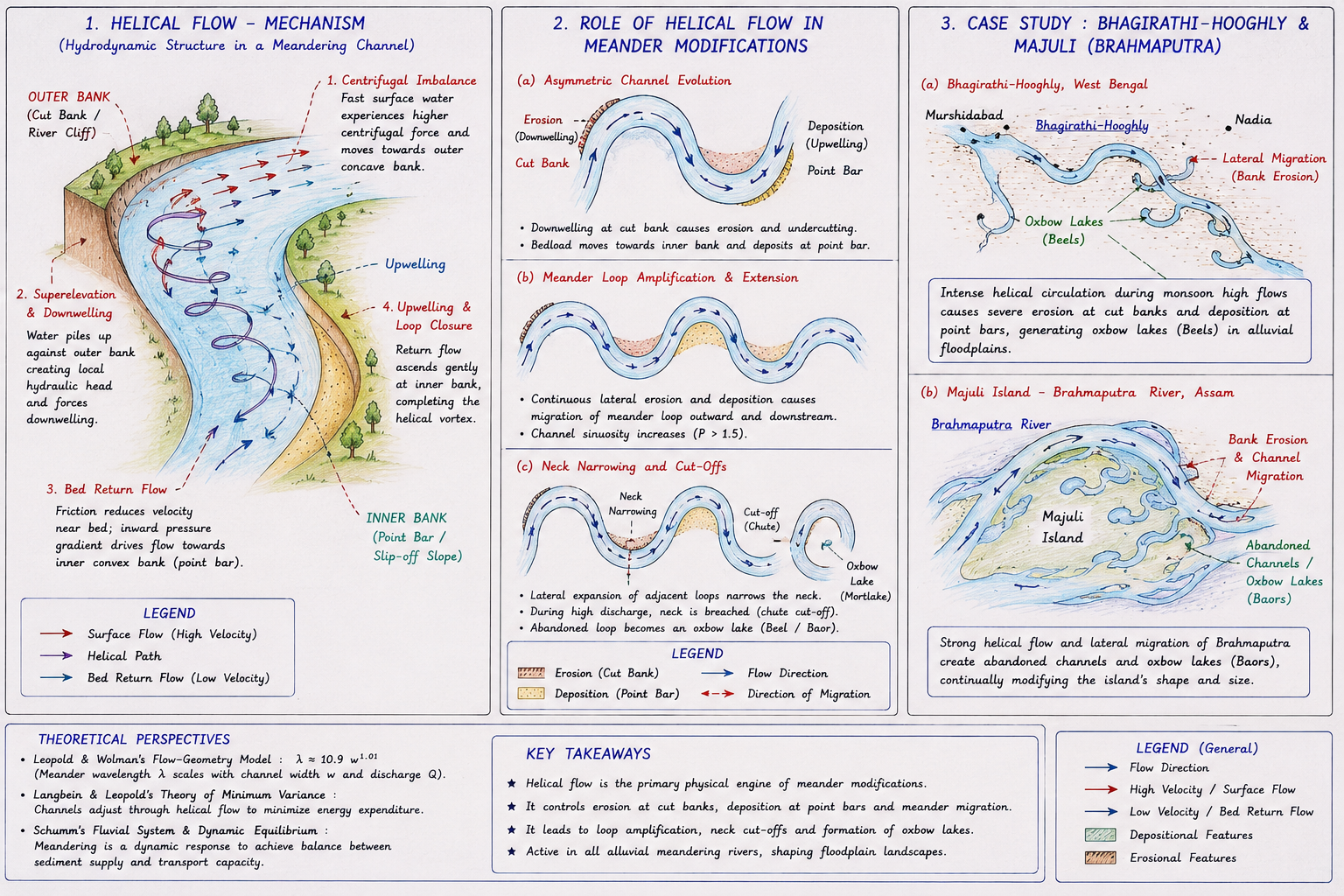
Helical flow (or helicoidal flow) is a three-dimensional, corkscrew-like secondary circulation pattern observed in channelized fluid dynamics. In fluvial geomorphology, it arises when the primary downstream longitudinal flow interacts with channel curvature, generating a cross-channel pressure gradient and centrifugal force differential between the surface and bed layers.
Hydrodynamic Mechanism
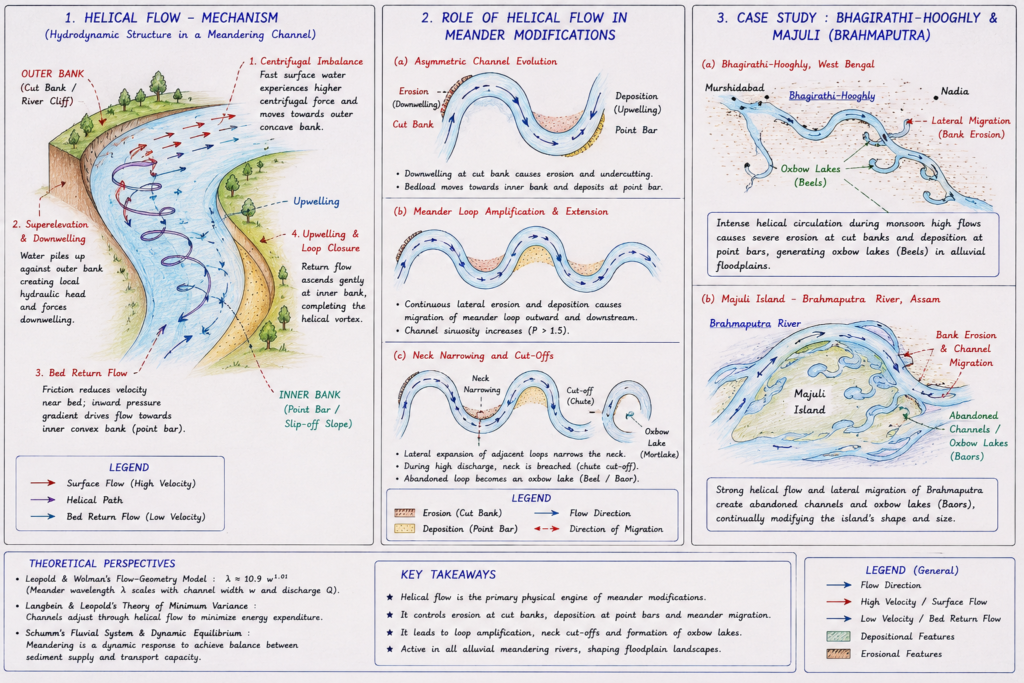
- Centrifugal Imbalance: Fast-moving surface water experiences higher centrifugal force, deflecting toward the outer concave bank (cut bank/river cliff).
- Superelevation & Downwelling: Water piles up against the outer bank, creating a local hydraulic head that forces downwelling along the concave slope.
- Bed Return Flow: Friction reduces velocity near the channel bed; hence, inward pressure gradients overcome centrifugal force, driving a cross-bed transverse current toward the inner convex bank (slip-off slope).
- Upwelling & Loop Closure: The return current ascends gently at the inner margin, completing the helical vortex.
$$\text{Downstream Velocity} + \text{Transverse Secondary Circulation} \longrightarrow \text{Helical Pathline}$$
Role in Meander Modifications
Helical flow is the primary physical engine driving lateral migration, sinuosity evolution, and planform metamorphosis:
- Asymmetric Channel Evolution:
- Erosion at Cut Bank: Downwelling velocities and concentrated shear stress accelerate hydraulic action and undercutting, maintaining a steep profile.
- Deposition at Point Bar: Inward bedload transport carries coarse bed materials up the convex slope, forming lateral accretion sets (point bars).
- Meander Loop Amplification & Extension: Continuous cross-valley asymmetry forces the loop apex outward (lateral migration) and down-valley (downstream sweep), increasing channel sinuosity ($P > 1.5$).
- Neck Narrowing and Cut-Offs: As adjacent meander loops expand laterally, the intervening neck thins. During peak discharge, high stream power initiates chute cut-offs or neck breaches, isolating the abandoned bend as an oxbow lake (e.g., mortlake).
Theoretical Perspectives and Models
- Leopold and Wolman’s Flow-Geometry Model: Demonstrates that meander wavelength ($\lambda$) scales directly with channel width (w) and discharge (Q), driven intrinsically by helical secondary cells:
- Langbein and Leopold’s Theory of Minimum Variance: Posits that meandering channels adjust their geometry via helical flow to achieve a uniform rate of potential energy dissipation (least work).
- Schumm’s Fluvial System & Dynamic Equilibrium: Meandering represents a dynamic response of suspended/mixed-load channels seeking equilibrium between sediment supply and transport capacity.
Case Study: The Bhagirathi-Hooghly & Majuli (Brahmaputra)
In the lower Gangetic delta plain of West Bengal (Bhagirathi-Hooghly stretch), intense helical circulation during monsoonal high-flow stages drives severe bank erosion along the Murshidabad-Nadia reach. This persistent lateral migration has detached historical loops, creating extensive oxbow complexes locally termed Beels and Baors, illustrating active meander metamorphosis in alluvial floodplains.
Helical flow serves as the self-regulating hydrodynamic mechanism through which a river optimizes its energy expenditure. By coupling erosional and depositional processes across channel bends, it drives the continuous morphological transformation of floodplains—bridging micro-scale fluid dynamics with macro-scale landform evolution in accordance with dynamic equilibrium.