
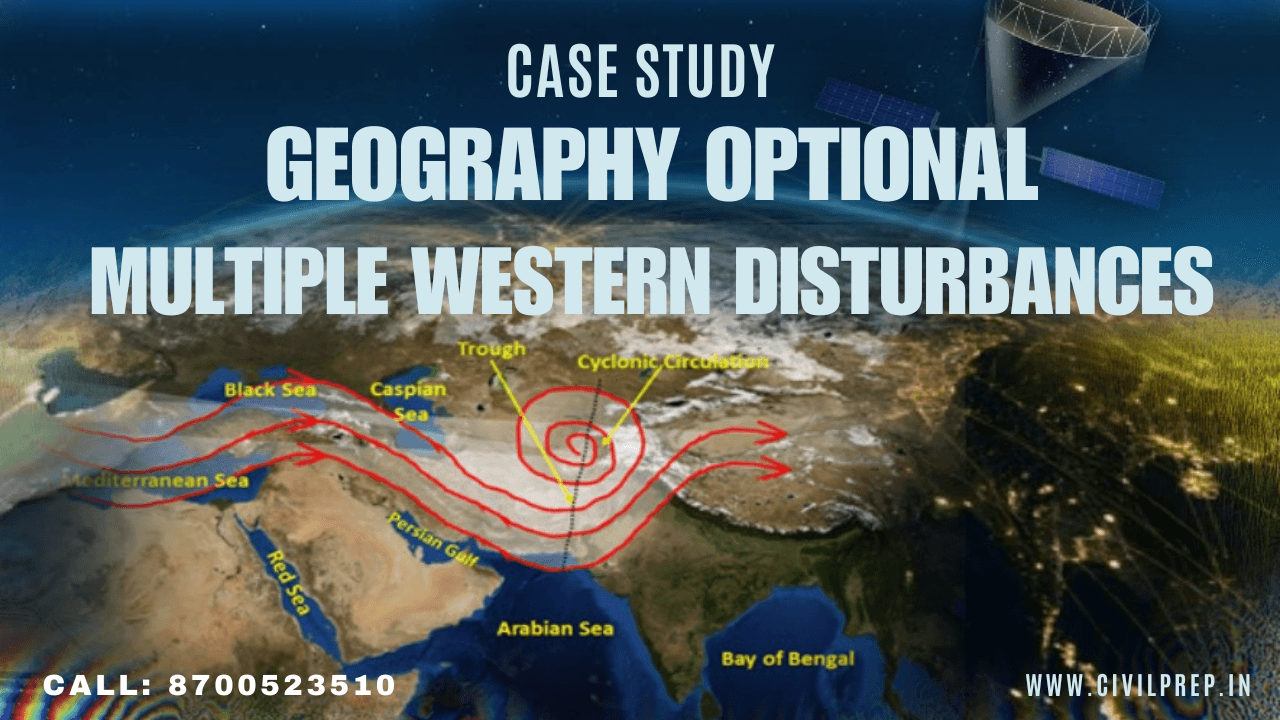
Western Disturbances: Geography Optional Perspective by Krishna Gupta
(Climatology, Physical Geography – UPSC Paper 1)
(Physical Settings, Indian Geography – UPSC Paper 2)
Background
Multiple Western Disturbances (WDs) forecast for late April 2026 will bring rain, thunderstorms, and dust storms to northwest/north India, interrupting the heatwave.
1. Mechanism: Jet Stream & Orographic Dynamics
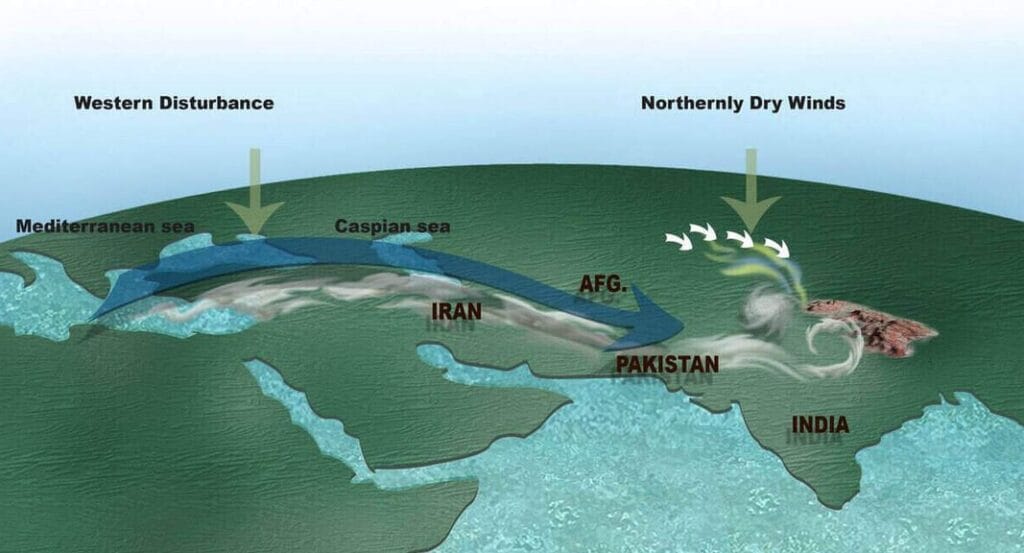
Subtropical Westerly Jet Stream Theory: WDs are extratropical cyclones (TCZs) embedded in the mid-latitude westerlies (200-300 hPa), originating over Mediterranean/Caspian Seas.
- Rossby Wave Theory: Long-wave undulations in jet stream troughs propel WDs eastwards (5-7 days to India).
- Cyclogenesis Model: Polar front + thermal gradient → low-pressure development (Norwegian Cyclone Model).
Orographic Lift Law: On reaching Himalayas, moist air ascends → adiabatic cooling → condensation (60% WD precipitation orographic). Latitudinal Energy Imbalance: Heat surplus (tropics) → poleward flux via WDs (Hadley-Ferrel cell interaction).
Diagram: Rossby Wave Path
Mediterranean Trough → Jet Stream → NW India
↓ Orographic Ascent (Himalayas) → Precip
2. Phenomena: Synoptic & Convective Interactions
Dust Storms: Haboob Phenomenon – downdraft outflows from WD thunderstorms lift Rajasthan dust (50-80 km/h winds). Thunderstorms: Conditional Instability – WD cold air over heat dome → CAPE ↑ → cumulonimbus formation. Rain/Hail: Bergeron-Findeisen Process – ice crystal growth in mixed-phase clouds.
April Anomaly: Delayed Jet Retreat (delayed monsoon trough) extends WDs into spring (Clausius-Clapeyron: warmer air = intense storms).
3. Impacts: Positive & Negative
| Aspect | Positive (Surplus Relief) | Negative (Disruption) |
|---|---|---|
| Thermal | ↓4-6°C; Heat budget rebalance (albedo ↑) | Cold shock; frost pockets |
| Hydrological | Rabi irrigation; GW recharge | Flash floods (foothills) |
| Agricultural | Moisture for wheat | Hail damage (Punjab) |
| Socio-economic | Air quality (dust wash) | Infra damage (₹100s Cr) |
Regional Variation: Indo-Gangetic surplus → Himalayan deficit redistribution.
4. Models, Theories, Laws & Perspectives
A. Synoptic Climatology Models
- Bjerknes Cyclone Model: WD development via divergence/convergence (upper divergence → ascent).
- Savinov Radiation Budget: WD clouds ↓ net radiation → cooling (σT⁴ ↓).
- GCMs (RegCM4): Simulate WD-Himalaya orographic enhancement; validate 70% winter precip.
B. Key Theories
- Polar Front Theory (Bjerknes): WD = warm/cold air mass convergence.
- Thermal Wind Theory: Jet speed ∝ horizontal temp gradient (heat dome accelerates).
- ENSO Teleconnection: La Niña ↑ WD frequency (Indian winter).
C. Physical Laws
- Hydrostatic Equation: orographic pressure drop → ascent.
- Clausius-Clapeyron Relation: 7%/°C moisture capacity → intense rain.
- Kirchhoff’s Law: Clouds (high ε) absorb/emit efficiently → greenhouse trapping.
D. Geographical Perspectives
- Spatial: Meridional Heat Flux – WDs transfer tropical surplus polewards (40 PW).
- Regional: Monsoon-WD Contrast – Winter precip (WD) vs summer convection (ITCZ).
- Human-Environment: Agri dependence (rabi crops) vs urban vulnerability (flooding).
- Climatic Change: Regime Shift – Warming extends WDs → erratic rabi harvest.
- Deterministic: Jet-Himalaya interaction dictates NW India aridity-wetness cycle.
Integrated Framework:
Jet Stream (Theory) → Orography (Law) → Precip (Model) → Heat Balance (Spatial Perspective)
5. Way Forward
- Forecasting: High-res WRF Model with ensemble WD tracking (IMD Doppler).
- Mitigation: Hail Suppression (cloud seeding); resilient crops (wheat varieties).
- Policy: NDMP Integration – WD in Heat Action Plans; agri insurance (PMFBY).
- Research: Convection-Permitting Models (2km res) for hail/thunderstorm prediction.
Takeaway: WDs exemplify dynamic climatology – synoptic processes (models/theories), physical laws, and regional perspectives shaping India’s NW hydroclimate. Quote: “Western Disturbances = Winter Monsoon of Himalayas”.
Tag:Best Geography Optional Explanation, Best Geography Optional Faculty, Best Platform for Geography Optional, case studies, Case Study, Case Study Mains 2025, Geography Case Study, Geography Optional, geography optional case study, Geography Optional Pyq, geography optional pyq 2024, human geography, india weather western disturbances, models theories laws and perspective in geography

You may also like

UPSC Geography Optional Solved 2024 PYQ
Possibilism – A Human Centred Approach by CivilPrep