
Geography Case Study: Climate Capitalism and the Geography of Unequal Finance
Context
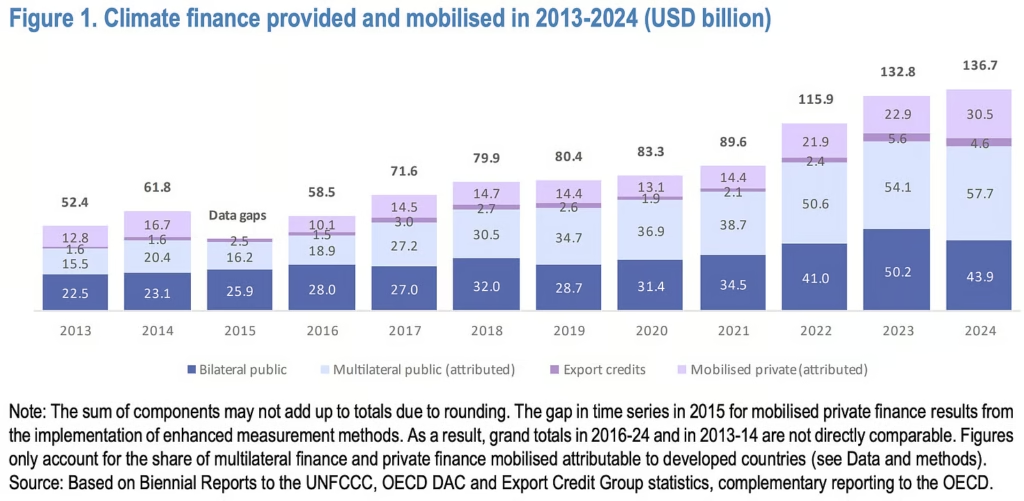
This case study examines the unequal geography of climate finance, where developed countries mobilised $136.7 billion in 2024 but low-income countries received only 7%. The OECD also notes that adaptation finance reached just $34.7 billion in 2024, so the distribution gap remains serious.
Concept
Climate finance means funding for mitigation and adaptation, but from a geography perspective it also shows how resources, power and vulnerability are unevenly spread across space. In this case, the key issue is not only total volume, but also who receives finance, in what form, and for which region or sector.
Perspectives
World-systems perspective: Immanuel Wallerstein described the world economy as an “axial division of labor” between core and peripheral zones, which explains why finance concentrates in strong economies.
Radical / Marxist perspective: Karl Marx stated, “The history of all hitherto existing society is the history of class struggles,” which helps explain climate finance as a struggle over resources and power between wealthy and vulnerable states.
Dependency perspective: Andre Gunder Frank stated, “underdevelopment is not original or traditional; it is the product of the same historical process that generated economic development.” This fits climate finance patterns where poorer regions remain dependent on external, often debt-based, funding.
Models
Centre–periphery model: Wallerstein’s model shows that core regions control capital, technology and decision-making, while peripheral regions remain dependent.
Limits to Growth model: Donella Meadows and colleagues argued that if present trends in population, industrialization, pollution, food production and resource depletion continue, the planet will hit limits and face sudden decline. This model is useful here because it shows that endless growth is impossible on a finite planet, making fair and restrained climate finance essential.
Hazard–exposure–vulnerability model: Used in OECD adaptation analysis, it shows risk as the interaction of hazard incidence, exposure and vulnerability, which is useful for explaining why low-income countries need more grant-based adaptation support.
Theories
Marxist theory: Marx’s class struggle approach explains climate finance as part of a capitalist system where wealthier actors retain control over the flow of resources.
Climate justice theory: Brandon Wu said, “those who have done the most to cause the climate crisis… must also do the most to fix it,” which supports demands for fairer support to vulnerable countries.
Laws
Gravity model: Walter Isard’s gravity principle suggests flows are stronger toward larger and more connected economies, which helps explain why finance goes mainly to middle-income countries.
Distance decay principle: Interaction weakens with spatial, institutional and informational distance, so fragile states attract less finance even when need is greater.
Way Forward
The policy focus should shift from headline totals to justice, grants and access. Developed countries should expand adaptation finance, reduce debt-creating loans, and simplify access for least developed countries and small island states. The Limits to Growth model also supports the idea that sustainable development must respect ecological limits rather than pursue endless growth.
For Admission Call or Whatsapp: 8700523510
Tag:Best Faculty for geography, Best Faculty for Geography Optional, best geography course for upsc mains, Best Geography Optional Case Studies, Best Geography Optional Explanation, Best Geography Optional Institute, Best Geography Optional Mentor, Best Geography Optional Mentorship, Best Institute for Geography Optional, case studies, Case Study, Case Study Mains 2025, civilprep, civilprep by krishna gupta, Geography Case Study, Geography Optional, geography optional case study, human geography, models theories laws and perspective in geography