
Case Study: Climate Change and Crop Yield Decline in India
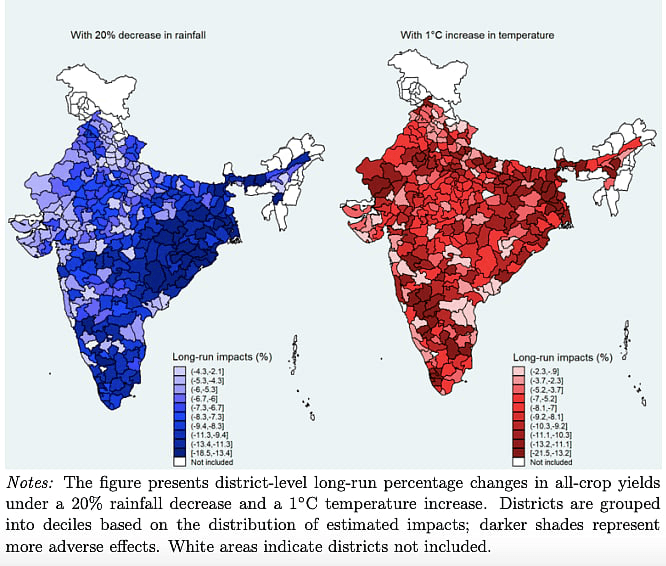
A 51-year district-level study across India found that a 1°C rise in temperature reduces national average crop yields by about 7.8%, while a 20% rainfall deficit cuts yields by 8.2%; the study covered 563 districts and 10 major crops, with pearl millet and maize among the worst affected. This makes the issue highly relevant for Geography Optional because it links climate change, agricultural productivity, regional inequality, food security, and human adaptation.
1. Context
India’s agricultural system is increasingly vulnerable to climatic stress, especially rising temperatures and erratic rainfall. In some districts, yield loss may reach up to 39%, showing that climate change is not just an environmental issue but a spatially differentiated developmental challenge.
2. Concept
The case reflects the interaction of atmosphere, hydrosphere, biosphere, and human systems in shaping agricultural landscapes. It shows that climate variability directly affects crop phenology, productivity, rural livelihoods, and food prices.
3. Perspectives of Human + Environmental Geography
Neo-determinism – Griffith Taylor: nature sets limits, but humans can act wisely within them; India’s agriculture must adjust to climatic thresholds rather than ignore them.
Human ecology – Harlan Barrows: geography studies man–environment relationships; this case shows how rural society is embedded within environmental stress.
4. Models in Human + Environmental Geography
Von Thünen’s Agricultural Land Use Model: changing temperature and rainfall may alter crop location, input intensity, and profitability across regions.
Boserup’s model of agricultural intensification: environmental pressure may compel innovation, irrigation, crop diversification, and better land management.
5. Theories in Human + Environmental Geography
Malthusian theory – Thomas Malthus: population growth can outstrip food production when environmental constraints intensify; climate-induced yield decline sharpens this concern.
Possibilism – Vidal de la Blache: despite constraints, human agency through technology, policy, and adaptation can reduce agricultural vulnerability.
6. Laws in Human + Environmental Geography
Liebig’s Law of the Minimum: crop yield is controlled by the scarcest factor; here, heat and rainfall become limiting controls.
Tobler’s First Law of Geography: impacts are spatially uneven but regionally connected; adjoining agro-climatic zones often show similar vulnerability patterns.
7. Way Forward
A techno-centric approach calls for heat-tolerant seeds, climate-smart irrigation, weather advisories, crop insurance, and precision agriculture. A Gandhian approach stresses local resilience, sustainable farming, water conservation, millet revival, and low-input agriculture. Neo-determinist planning suggests development should align with ecological limits, while India must combine productivity with sustainability to secure food and farmer livelihoods.
Tag:best geography course for upsc mains, Best Geography Optional Case Study, Best Geography Optional Explanation, Best Geography Optional Faculty, Best Geography Optional Institute, Best Geography Optional Test Series, Best IAS Institute in India, case studies, Case Study, Case Study Mains 2025, Geography Case Study, Geography Optional, geography optional case study, human geography, models theories laws and perspective in geography, upsc 2026